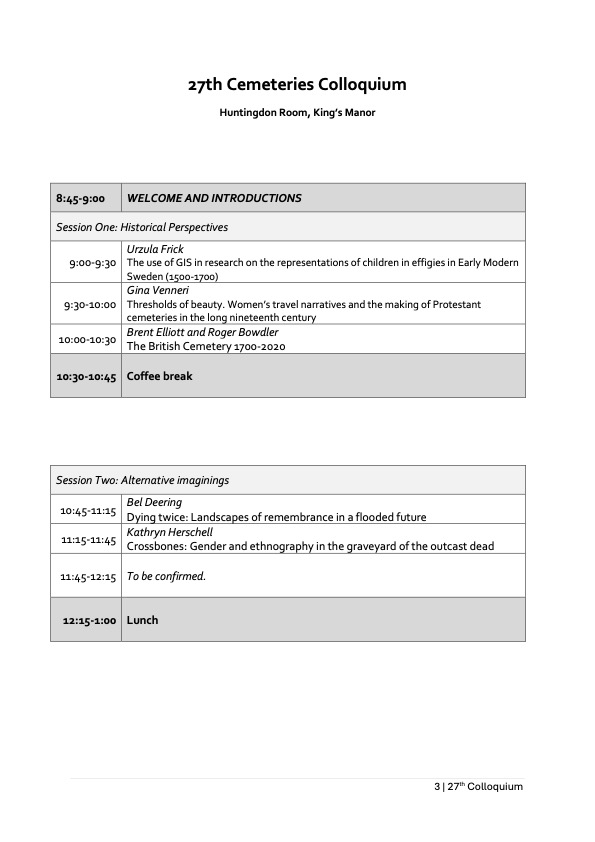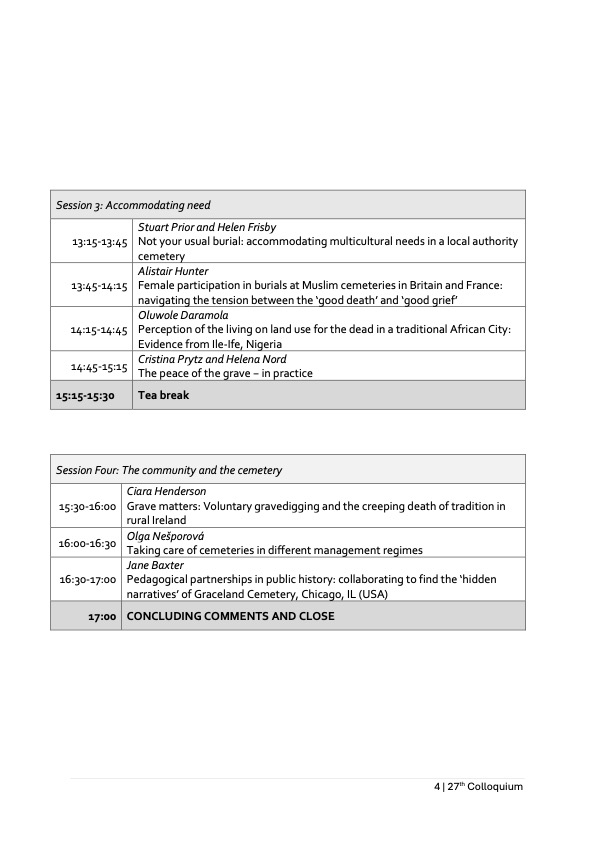
On 8 May I attended the 27th Cemeteries Colloquium, hosted by the University of York. This interdisciplinary annual conference was a fantastic opportunity to learn from a wide array of cemetery experts – across the fields of anthropology, archaeology, history, urban planning, architecture, art history, gender studies, and climate science. (The full conference programme is included at the bottom of this post).
Here are some bits and pieces that I found the most thought-provoking and plan to look further into:
- Cemeteries as decoupage (Bel Deering)
- Shakespeare’s own epitaph being copied in the 18th century to fend off the increasingly common phenomenon of bodysnatching (“Blessed be the man that spares these stones, and curst be he that moves my bones”) (Robert Hartle)
- The article “Reimagining memorial spaces through digital technologies” in Death Studies 48:8 (2024), by Fraser Allison et al
- Crossbones Graveyard in London with 15,000 pauper burials, including medieval sex workers – now a remembrance garden and memorial to various demographics who are outcast or outside society (Kathryn Herschell)
- “NodeGoat” software – network analysis and interactive visualisation tool for Humanities data (Urzula Frick)
- Cemeteries as spaces of spatial negotiation (Gina Venneri)
- Newly released book (last week) – The British Cemetery: Architecture, Landscape, Sculpture by Brent Elliott and Roger Bowdler, a definitive major work from Historic England and Liverpool University Press
- Muhammad’s Grave: Death Rites and the Making of Islamic Society, 2011 book by Leor Halevi from Columbia University Press
- The role of written words to turn space into place (Gina Venneri) – what ramifications does this have for epitaphs?
As you can see, the colloquium has provided lots of further mulling and reading topics for me to explore in the coming weeks!