1. What have you been working on this month for the project?
I’ve continued hunting for Shakespeare in epitaphs, obituaries, and memorial addresses, and our list of quotations used for these purposes continues to expand. Finding quotations from Taming of the Shrew (“’tis the mind that makes the body rich”) and Love’s Labour’s Lost (“a merrier man, / Within the limit of becoming mirth, / I never spent an hour’s talk withal”) was a major milestone, as it means we’ve now identified passages from ALL of Shakespeare’s plays (as well as many of the poems) in commemorative contexts. At the same time, I’ve begun planning out a few case studies, so with luck I’ll be able to turn to some actual writing before long.
2. What is your favourite or most surprising thing you’ve learned on the project this month?
I’ve become slightly obsessed with this unique memorial to a Michigan man who died in 1899. The grave marker is in the form of a tree, with the inscription “MY DAINTY ARIEL”.
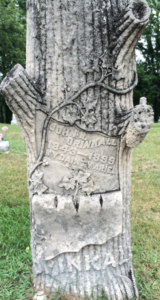
Why this quotation from The Tempest? Why a tree? There seem to be several possible answers. My first thought was that the shape of the monument might refer to Ariel’s reported imprisonment in “a cloven pine”, from which Prospero claims to have freed him. In a funerary context, oblique reference to that passage might suggest an idea of death as a release from torment or confinement. On the other hand, the tree may have nothing to do with the Shakespearean quotation. The death certificate for John R. Drinkall gives his cause of death as “Scull fractured by a falling tree.”
My hunch is that the short quote is meant to conjure the lines that follow immediately after in Prospero’s speech: “I shall miss / Thee, but yet thou shalt have freedom.” In that case, both the epitaph and the form of the monument (if it’s the “cloven pine” from the play) would suggest that death came as a relief and release for the deceased — something one might not want to state explicitly on a memorial. But that explanation leaves aside the fact that a tree was the literal instrument of his death…. I suspect I’ll be puzzling over this for a while yet.
3. Have there been any challenges for your work on the project this month?
Changing commemorative practices in the internet age pose a challenge when it comes to deciding what to include in our data. It’s increasingly common for obituaries to be posted directly to websites like Legacy.com, where the deceased’s loved ones can post their own tributes as replies. There’s a lot of Shakespeare on these pages, including some quotations we haven’t come across anywhere else. Nevertheless, we’ve decided to hold off on recording them in the database for now. The issue is that these posts can feel closer to social media than traditional printed obituaries. My instinct is that “commemorative speech” (as opposed to the broader field of talking-about-the-dead) has to be tied to some formal instrument of commemoration: be it a grave inscription, a published death notice, or a memorial address. But perhaps all those modes of remembrance are on their way out…. No final decisions have been made as yet — it might be a good topic for discussion when our Advisory Board meets in June.
4. What are you looking forward to coming up for the project?
I’m looking forward to doing some real writing. We’re still in the first year of a three-year project, so it’s not yet time for writing up results — but I seem to get my best thinking done when I’m putting down words in a notebook or on a screen.